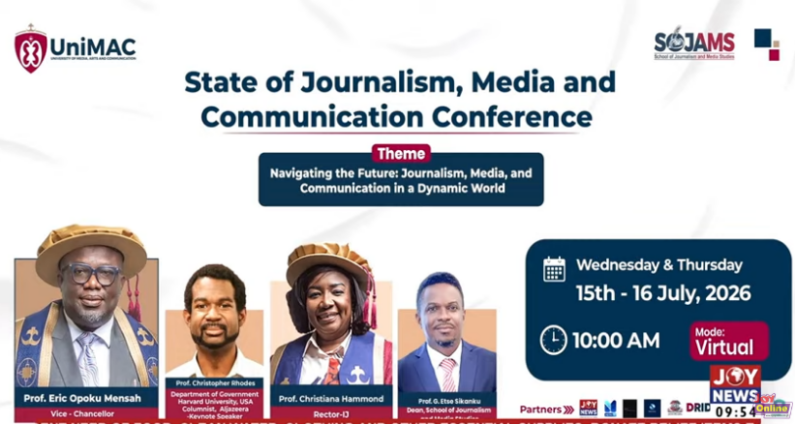
The University of Media, Arts, and Communication (UniMAC) has opened its maiden State of Journalism, Media, and Communication Conference (SJMCC 2026), bringing together academics, researchers, journalists, and communication experts from across the world to discuss the future of the media industry.
The two-day virtual conference, which began on Wednesday, July 15, is being held on the theme “Navigating the Future of Journalism, Media, and Communication in a Dynamic World.” It marks UniMAC’s first major international academic conference since the merger of the Ghana Institute of Journalism (GIJ), the National Film and Television Institute (NAFTI), and the Ghana Institute of Languages (GIL).
Speaking at the opening ceremony, the Pro Vice-Chancellor of UniMAC, Prof. Winston Kwame Abroampa, described the conference as the beginning of what he believes will become a globally recognised platform for journalism and communication research.
Delivering the welcome address on behalf of the Vice-Chancellor, Prof. Eric Opoku, Prof. Abroampa said SJMCC would provide a space for reflection, dialogue, collaboration, and solutions to challenges facing the media industry.
He explained that the conference would examine critical issues shaping modern journalism, including artificial intelligence, misinformation, fact-checking, technology and democracy, media ownership, journalism education, investigative reporting, science and environmental journalism, strategic communication, and media’s role in society.
Prof. Abroampa noted that these discussions are connected by one major question: how to build media systems that genuinely serve the public interest. He stressed that protecting the integrity of the information ecosystem requires collective efforts from journalists, universities, governments, and technology companies.
He also encouraged participants to use the conference to build lasting research partnerships that can influence policy, improve professional practice, and strengthen scholarship.
A keynote speaker at the conference, Prof. Christopher Rhodes, Senior Lecturer in the Social Sciences at Boston University and Lecturer in the Department of Government at Harvard University, challenged journalists to pursue truth beyond simply reporting facts.
Speaking virtually, Prof. Rhodes highlighted the historic role of newspapers in Ghana’s independence struggle, noting that African journalists and editors used publications to shape public opinion and mobilise resistance against colonial rule.
He referenced publications such as Dr. Kwame Nkrumah’s Accra Evening News, which he described as a significant tool in Ghana’s independence movement.
However, Prof. Rhodes cautioned that journalism can also be influenced by political interests, stressing the need for journalists to maintain independence and integrity.
“Journalists commit to both facts and truth, but we must not confuse one for the other,” he said, adding that reporting facts accurately is the foundation of journalism but not its final purpose.
He urged journalists to report facts fully and honestly while going beyond information gathering to uncover deeper truths that serve society, especially at a time of rising misinformation, disinformation, and declining public trust in institutions.
The conference features keynote presentations, plenary sessions, roundtable discussions, and research panels focused on addressing emerging challenges and opportunities within journalism, media, and communication.
UniMAC Opens Maiden Journalism Conference as Prof. Christopher Rhodes Urges Journalists to Pursue Truth Beyond Facts
UniMAC Opens Maiden Journalism Conference as Prof. Christopher Rhodes Urges Journalists to Pursue Truth Beyond Facts