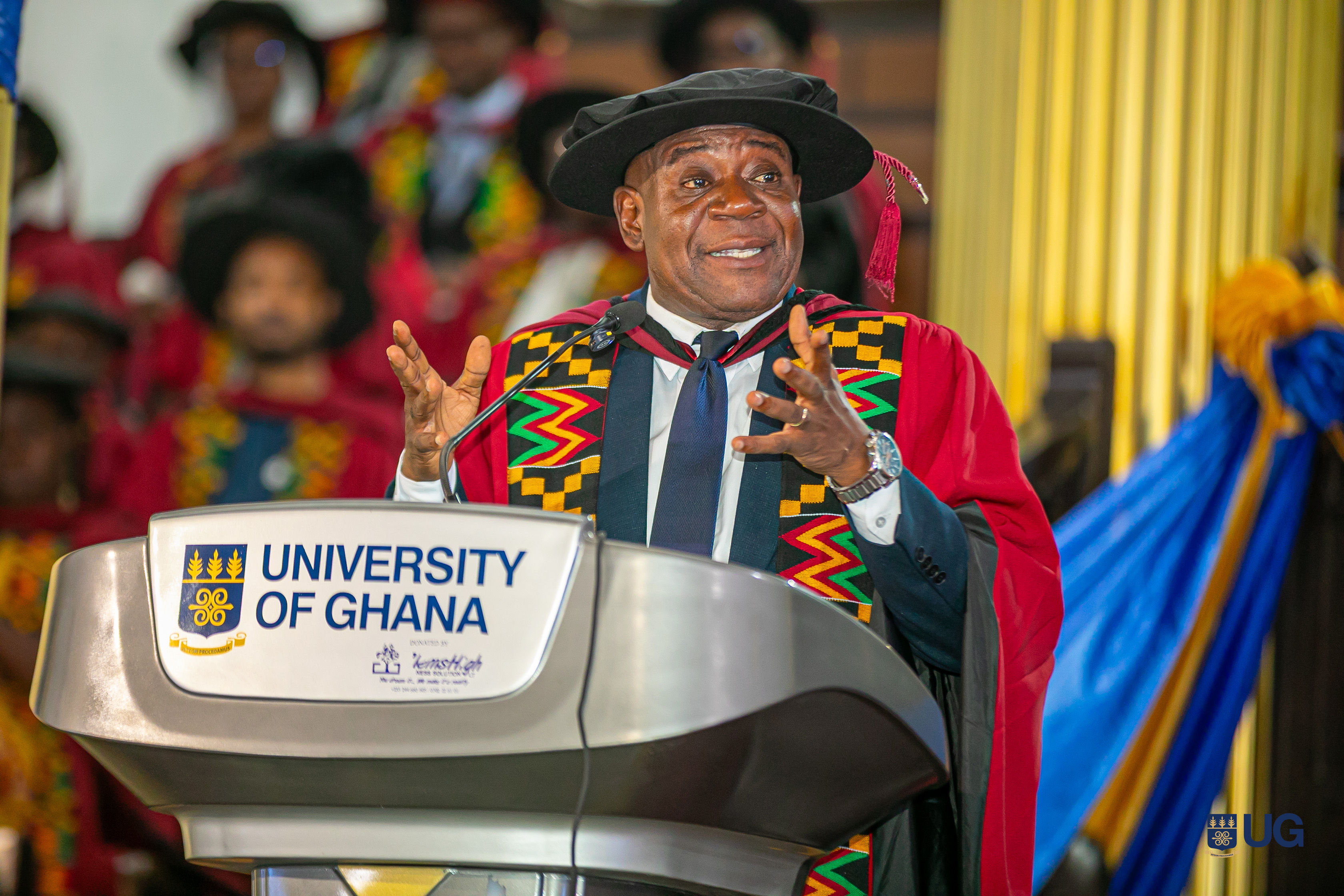
Professor Samuel Nii Ardey Codjoe, Professor of Population Studies at the Regional Institute for Population Studies (RIPS) and Pro Vice-Chancellor for Research, Innovation and Development at the University of Ghana (UG), has called for greater integration of indigenous knowledge with scientific research to strengthen climate adaptation and healthcare delivery in Ghana and across Africa.
Professor Codjoe made the call when he delivered his Inaugural Lecture at the University of Ghana, titled “Reading the Skies and Healing in the Land: Climate, Indigenous Knowledge and Health.”
Drawing on research conducted in communities across Ghana, he examined the links between climate change, indigenous knowledge and health, emphasising that climate change should be treated not only as an environmental issue but also as a major health challenge with social, cultural and economic consequences.
He noted that communities experience the effects of climate change through rising temperatures, changing rainfall patterns, flooding and drought, all of which have implications for health and livelihoods.
Professor Codjoe explained that indigenous knowledge can provide useful information about environmental changes, particularly in communities where access to conventional scientific weather data is limited.
He said communities have traditionally relied on signs such as frog sounds, the appearance of the moon, bird movements, changes in the sea, rainbows and the behaviour of ants to anticipate weather and rainfall patterns.
He therefore called for indigenous knowledge to be considered alongside scientific knowledge when developing climate adaptation and health interventions.
Presenting findings from studies conducted in Accra and Tamale, Professor Codjoe noted that indoor temperatures in some homes and public facilities were significantly higher than temperatures recorded at conventional meteorological stations.
According to him, reliance solely on conventional weather measurements could therefore underestimate the level of extreme heat experienced by some households.
On flooding, he identified inadequate drainage, poor waste disposal, construction in flood-prone areas and low coastal elevation as contributing factors.
Research conducted in communities including Glefe, Mpoase and Agbogbloshie also revealed disagreements among stakeholders over the causes of flooding, which Professor Codjoe described as a “blame game”.
He recommended stronger involvement of traditional and community leaders in flood-risk management and suggested that informal institutions could be partially integrated into formal metropolitan structures.
Professor Codjoe further highlighted the impact of extreme weather on healthcare delivery.
He said extreme heat, poor ventilation, water shortages and power outages could affect patient care, medicines, vaccines and the working conditions of health professionals.
Flooding, he added, could damage medical equipment and medicines, disrupt electricity supplies and cut communities off from healthcare services.
To address these challenges, he recommended improved ventilation, better drainage systems, contingency plans for power outages, solar-powered cooling systems and effective early-warning systems for floods and extreme heat.
He stressed that such warning systems should be integrated into existing communication structures to ensure that communities can receive and respond to timely information.
The lecture also highlighted practical interventions that emerged from Professor Codjoe’s research and community engagement.
These included community climate change clubs, a 144-metre drain constructed in Agbogbloshie, waste disposal facilities in James Town, a fish-smoking facility in Sempe and a shed for fishmongers in Ussher Town.
Professor Codjoe said combining scientific knowledge with local understanding could strengthen health systems, improve climate adaptation strategies and contribute to building more resilient communities in Ghana and across Africa.
New Initiatives for Academic Recognition
As part of his vision as Pro Vice-Chancellor for Research, Innovation and Development, Professor Codjoe announced plans to extend the Pen Ceremony, which he introduced during his tenure as Provost of the College of Education, to other colleges of the University.
The initiative is intended to celebrate academics who have been promoted to the rank of Associate Professor and promote a culture of recognising academic achievement and faculty milestones.
He also pledged to sponsor additional LED screens at the Great Hall to support future inaugural lectures at the University.
In her remarks, the Vice-Chancellor of the University of Ghana, Professor Nana Aba Appiah Amfo, commended Professor Codjoe for his scholarship, research, mentorship and service to the University.
She congratulated him on his appointment as Pro Vice-Chancellor for Research, Innovation and Development and wished him success in his new role.
Professor Codjoe joined the University of Ghana in 2004 and attained the rank of Professor in 2015. He is the immediate past Provost of the College of Education and has held several academic and leadership positions at the University and beyond.
His research interests include climate change, population dynamics, migration, health, food security and sustainable development.
A week-long exhibition of his scholarly works was also held at the Balme Library as part of activities marking the inaugural lecture.
The event brought together academics, industry representatives, government officials, members of the diplomatic community, students, alumni, family and friends, with various University units, departments, family members and Promasidor Ghana presenting gifts in recognition of his academic and professional contributions.
UG Professor Calls for Integration of Indigenous Knowledge into Climate and Health Policies
UG Professor Calls for Integration of Indigenous Knowledge into Climate and Health Policies